




Orders are scheduled until 2027! The electronic fabric track is racing fiercely, and the leading performance is expected to increase by 364%
On July 23rd, according to CCTV Finance, since the beginning of this year, driven by the explosive demand for AI computing power, high-end printed circuit boards (PCBs) have been in short supply, and prices have continued to rise. Top manufacturers' orders have been locked in until 2027, and both upstream and downstream industries have felt the impact.
Recently, several PCB suppliers have issued price increase letters, and the responsible persons of related enterprises have introduced that "the price increase of high-speed PCBs has far exceeded three to four times".
It is understood that high-end printed circuit boards (PCBs) have strict requirements for production processes and raw material quality. Copper clad laminates (CCL), as the core substrate of PCBs, are currently in short supply and their prices have risen, which has also pushed up the production cost of PCBs and driven up the price of the industry chain.
Key substrate - electronic fabric
Electronic grade glass fiber cloth (referred to as electronic cloth) is a core reinforcing material for copper-clad laminates and PCBs. It is a plain weave fabric made of electronic grade glass fiber yarn that has been warp knitted, sized, and woven. It includes E-glass fiber cloth and special electronic cloth.
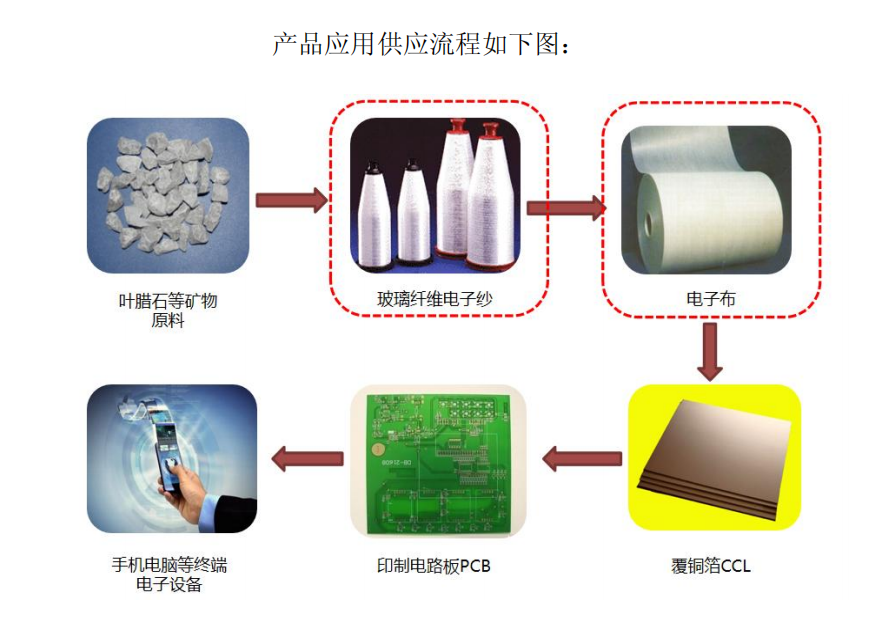
Image source: Honghe Technology
The product has a wide range of application scenarios, covering various high-tech electronic products such as smartphones, tablets, laptops, servers, 5G base stations, automobiles, consumer electronics, industrial controls, instruments and meters, medical machinery, aerospace, IC chip packaging substrates, etc.

Image source: Honghe Technology
In the first half of 2026, electronic fabric prices have undergone multiple rounds of price increases, and "monthly adjustments" have become the norm in the industry. Mainly due to the explosive demand for computing power, the demand for electronic fabrics has also increased significantly, and the market is in short supply. In addition, the rise in manufacturing costs has driven up the price of electronic fabrics significantly.
In early July, electronic fabric giant Fuqiao Industrial announced an increase in electronic fabric prices: among them, ordinary E-glass electronic fabric for traditional PCB and consumer electronics fields was uniformly increased by 30%; Low dielectric constant (Low DK2) electronic fabric for applications such as AI servers and high-speed high-frequency boards has increased in price by 15%, and it has been reported that multiple mainstream models of products are in short supply. See details: China's giant stones hit the daily limit up! Electronic fabric: Price increase of 30%
The global high-end fiberglass cloth market is highly concentrated, with Nissin holding over 90% of the global market share. Domestic manufacturers are accelerating their breakthrough, with major representative production enterprises including Honghe Technology, China Jushi, Sinoma Technology, International Composite Materials, and Feilihua.
Honghe Technology
Honghe Technology was founded in August 1998 and listed on the Shanghai Stock Exchange in July 2019. It focuses on the research, production, and sales of high-end E-glass fiber fabrics such as ultra-thin and ultra-thin fabrics, as well as special electronic grade glass fiber fabrics such as low dielectric and low thermal expansion coefficients.
It is one of the few domestic manufacturers with the ability to produce extremely thin fabrics, and its subsidiary Huang Shihong has the ability to produce 3-micron ultra-fine electronic grade glass fiber yarn. At present, the company has achieved integrated production and operation of electronic yarn and electronic fabric, with downstream customers including well-known companies such as Shengyi Technology, Lianmao Electronics, Taiguang Group, Taiyi Technology, and Nanya New Materials. Its Low-Dk2.3 fiberglass yarn products have been certified by companies such as NVIDIA and TSMC, and can supply high-end servers and AI chip packaging substrates.
At present, the company's Q fabric has passed downstream customer certification and has the ability to mass produce. It will produce Q fabric according to customer order requirements. The weaving machine will arrive according to the schedule in the future.
In terms of performance, Honghe Technology expects a net profit attributable to shareholders of the listed company of RMB 332 million to RMB 405 million for the first half of 2026, a year-on-year increase of 280% to 364%. The main reason for the expected increase in performance is the increased demand in the terminal market in the first half of 2026, resulting in an increase in the sales quantity and unit price of ordinary E-glass fiber electronic cloth, as well as an increase in the sales quantity of special electronic cloth. The company focuses on producing and selling urgently needed special electronic cloth and E-glass fiber ultra-thin and ultra-thin cloth products in the market, achieving a significant increase in net profit.
By 2025, the company's performance will achieve a leapfrog growth, with revenue of 1.171 billion yuan, a year-on-year increase of 40.31%; The net profit attributable to the parent company was 202 million yuan, a year-on-year increase of 78.55%. On the one hand, the price of ordinary electronic fabric increased year-on-year, and on the other hand, the company achieved mass production and delivery of high-performance special low dielectric electronic fabric and low thermal expansion coefficient electronic fabric, with good added value.
The gross profit margin of Honghe Technology's electronic grade fiberglass cloth industry in 2025 is 36.21%, an increase of 17.02 percentage points year-on-year. Among them, the revenue of special electronic fabric products was 178 million yuan, a year-on-year increase of 1326.94%, and its gross profit margin reached 61.31%, a year-on-year increase of 25.48 percentage points; The revenue of E glass fiber cloth products was 940 million yuan, an increase of 22.52% year-on-year, with a gross profit margin of 31.44%.


Main business gross profit margin in 2025
It is worth noting that on July 20th, Honghe Technology released a stock movement announcement, stating that the company's stock had a cumulative deviation of over 20% from the closing price on July 16th, 17th, and 20th, 2026, for three consecutive days. The company has noticed that some media have listed the company as a "PCB concept". The company stated that electronic grade fiberglass cloth is one of the basic materials for PCBs, and there is no significant change in the company's main business. After self-examination, there are no market rumors that need to be clarified, and there are no other significant issues that can significantly affect the stock price.
Chinese Giant Stone
China Jushi is a global leader in electronic fabric, affiliated with the state-owned China National Building Materials Group, mainly engaged in the production and sales of fiberglass and related products. The electronic fabric products currently produced are mainly ordinary fabric and thin fabric series. By 2025, the company will achieve a sales volume of 1.062 billion meters of electronic fabric, accounting for 17.77% of its operating revenue. Low dielectric and other special electronic fabric products have not generated orders or revenue.
In addition, it was announced in May 2026 that it plans to invest 4.431 billion yuan in Huai'an, Jiangsu to build a production line with an annual output of 50000 tons of electronic yarn and 320 million meters of electronic fabric. After the new project reaches production capacity, its electronic fabric production capacity will exceed 1.6 billion meters.
On July 15th, China Jushi announced that its wholly-owned subsidiary Jushi Group Co., Ltd. plans to invest 2.4047 billion yuan to build an electronic fabric production line with an annual production capacity of 250 million meters in Tongxiang Economic Development Zone, Zhejiang Province, using surplus electronic yarn from existing production lines as raw materials. The construction period is 1.5 years.
In terms of performance, the company expects a net profit attributable to the parent company of 2.784 billion yuan to 3.121 billion yuan in the first half of 2026, a year-on-year increase of 65% -85%. The performance growth is mainly due to the increased demand in the downstream application areas of fiberglass, resulting in a simultaneous increase in product quantity and price. The company has improved its profitability through measures such as accelerating product structure optimization, increasing technological innovation, and strengthening market development.
On July 20th, China Jushi also released a stock movement announcement, with a cumulative deviation of over 20% from the closing price for three consecutive days. After self-examination, the company's current production and operation are normal, with no significant changes in industry environment or policies, normal production and sales, and stable internal business order.
Zhongcai Technology
The three leading industries of Sinoma Technology are glass fiber and products, wind power blades and lithium battery separators. Its wholly-owned subsidiary, Mount Taishan Glass Fiber, focuses on the research, production and marketing of glass fiber and products.
In terms of special fiber fabrics, the company has built a total of 5 low dielectric and low expansion special fiber production lines. By 2025, 3 special fiber fabric projects with a total production capacity of 94 million meters have been approved and smoothly promoted. In 2025, the company will sell 19.17 million meters of special fiber fabrics throughout the year, covering all categories of low dielectric first generation, second generation, low expansion, and ultra-low loss low dielectric fiber fabrics. All of them have completed certification and bulk supply to domestic and foreign top customers, and their product performance is comparable to that of international top manufacturers.
On July 7th, Sinoma Technology announced that it will issue stocks to specific targets in 2025, with an expected total fundraising of no more than 4.481 billion yuan. After deducting issuance expenses, the net amount is planned to be invested in projects such as the annual production of 35 million meters of low dielectric fiber cloth and the annual production of 24 million meters of ultra-low loss low dielectric fiber cloth. The project products will ultimately be applied in fields such as AI servers and data center switches.
International Composite Materials
The main products of international composite materials include glass fiber and glass fiber products. In the field of wind turbine blades, the company has become one of the world's leading suppliers of wind turbine yarn and fabric, with a market share of over 25%. The polyurethane wind turbine yarn and fabric jointly developed with Covestro Polymer (China) Co., Ltd. has been used in all polyurethane wind turbine blades for the first time. In terms of high-end development, the company has successfully developed special fabrics such as LDK first generation, second generation, and low expansion for low dielectric electronic fabric. Low dielectric fiberglass used in 5G construction has achieved mass production.
International Composite Materials previously disclosed that the company's wind power yarn, electronic fabric, especially high-frequency and low dielectric related products are operating at full capacity, with sufficient inventory of orders in hand. The company is advancing the construction of a high-frequency high-speed electronic fiber cloth project with an annual output of 36 million meters. In addition, the company's annual production of 80000 tons of electronic grade glass fiber intelligent manufacturing production line has been ignited within 2025, and production is normal and stable.
The performance forecast shows that in the first half of 2026, international composite materials achieved a net profit attributable to the parent company of 580 million yuan to 680 million yuan, an increase of 151% -194% compared to the same period last year. The company continues to promote product structure optimization, achieving dual growth in product quantity and price. The prices of electronic grade fiberglass and products have increased, and net profit has significantly increased year-on-year.
It is worth mentioning that the company recently announced that Mr. Mo Qiushi, the chairman, has resigned from his positions as chairman, director, chairman of the strategic committee, member of the strategic committee, and member of the nomination committee of the third board of directors due to work adjustments. The above-mentioned positions were originally scheduled to serve until May 27, 2027.
PHILIP
Feilihua focuses on the research and production of quartz glass and quartz glass fiber materials, with a variety of high-end ultra thin fabrics, ultra thin fabrics, ultra fine yarns, ultra fine yarns, as well as high-performance electronic grade quartz fibers and quartz fabrics with ultra-low dielectric and ultra-low expansion coefficients.
The current quartz electronic fabric products of the company are still in the stage of small-scale testing on the client side and certification for end customers. Due to uncertain factors such as customer product iteration and adaptation testing, there is uncertainty in business cooperation and orders. By 2025, the sales revenue of quartz electronic cloth products will reach 98.3737 million yuan. At present, the construction of Dingyi New Materials, Zhongyi New Materials' electronic fiber yarn and ultra-thin quartz electronic cloth projects has started successively, and the construction of quartz electronic yarn (1000 tons) and quartz electronic cloth projects is progressing in an orderly manner according to plan.
According to the performance forecast, Feilihua expects a net profit attributable to its parent company of 270 million to 310 million yuan in the first half of 2026, a year-on-year increase of 21.78% to 39.82%. Mainly due to the steady growth of revenue in the semiconductor sector, coupled with the continuous expansion of global AI computing power and the increasing demand for quartz electronic fabric testing, quartz electronic fabric is expected to achieve sales revenue of 150 million yuan in the first half of the year.
In general, with the continuous expansion of AI applications in the future, PCB boards need to meet strict requirements such as high frequency, high speed, low signal loss, and high heat dissipation performance. Electronic fabric, as one of the core raw materials of PCB boards, will continue to iterate and upgrade towards high functionality such as low dielectric and low thermal expansion coefficient. In addition, in the high-end consumer electronics field, terminal electronic devices such as smartphones and tablets are constantly developing in the direction of "thin, light, short, and small". Electronic fabrics will also continue to develop in the direction of thin and lightweight, so the demand for special electronic fabrics will continue to increase.