




Latest achievements! Chinese scientists achieve low-temperature and efficient degradation of PFAS
On November 20th at 24:00, the international academic journal Nature published online the research results of Chinese scientists achieving low-temperature and efficient degradation of "permanent chemicals".
Perfluoroalkyl and polyfluoroalkyl substances (PFAS) have unique thermal stability, chemical stability, hydrophobic and oleophobic properties, and are widely used in fields such as chemical engineering, electronics, medical equipment, textile machinery, and nuclear industry. However, it is difficult to degrade in natural environments or under mild conditions.
For example, Teflon can last for many years without decomposing at a temperature of 260 degrees Celsius, but when it decomposes above 500 degrees Celsius, it releases toxic gases. Therefore, perfluorinated and polyfluoroalkyl substances are referred to as "permanent chemicals". The perfluorinated and polyfluoroalkyl substances discarded in nature are difficult to recycle and have caused a series of environmental and health problems.
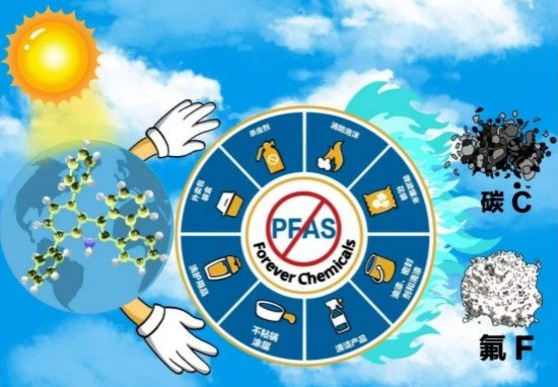
PFAS utilizes super organic photoreduction agents to defluorinate, decompose minerals, and recover carbon and fluorine resources.
In response to the above challenges, Professor Kang Yanbiao's research team from the University of Science and Technology of China and Professor Qu Jianping from Nanjing University of Technology have developed a super organic photoreduction agent named KQGZ based on the strategy of promoting electron gain and loss through distortion. This agent has achieved complete destruction and defluorination of Teflon and small molecule perfluorinated and polyfluoroalkyl substances at low temperatures, and efficiently recovered them into inorganic fluoride salts and carbon resources.
It is reported that the super organic reducing agent KQGZ is a unique and original photocatalytic catalyst independently designed and created by Chinese scientists, which has broad-spectrum catalytic properties for breaking strong carbon impurity and impurity impurity atomic bonds; In over a hundred types of reactions that have been attempted so far, ideal results have been achieved. Experimental results have shown that its twisted structure effectively promotes the gain and loss of electrons, thereby achieving super reduction and providing new ideas for the design and development of new super photoreduction agents.